


Beyond Accessibility Scans: A New Testing Patent and Its Relevance to Software IP Disputes
Technical-information note: This article explains a published software testing invention and its potential relevance to technical investigations. It is not legal advice or an expert opinion about a particular product, patent, or dispute.
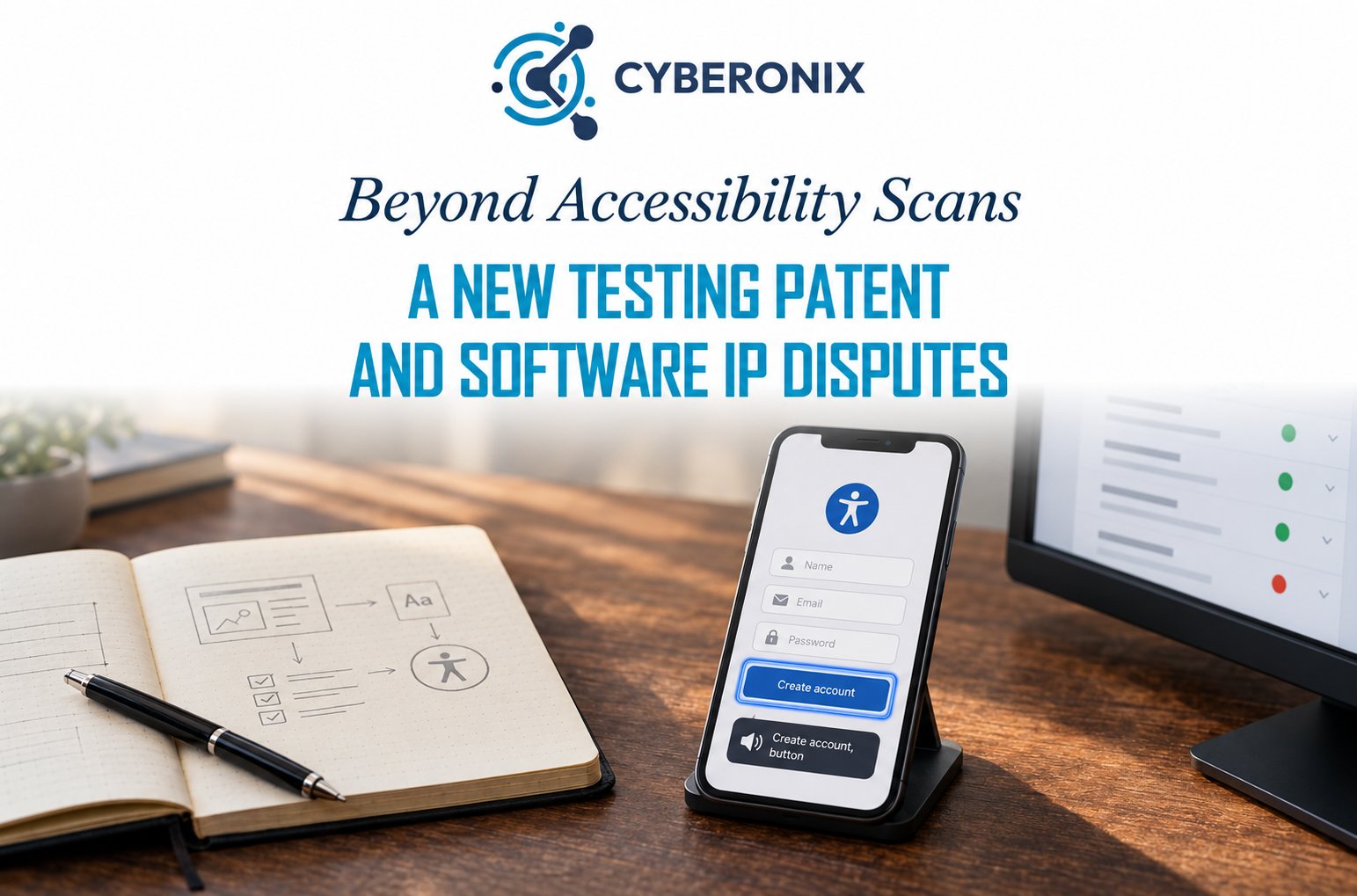
A test script finds a registration button, clicks it, fills in a form, and creates an account. The test passes. A user navigating the same app with a screen reader may encounter a different result: the button cannot be reached, so registration never begins.
Both observations can be accurate. They describe different ways of interacting with the software.
That distinction is central to U.S. Patent No. 12,724,698 B2, Automated Assistive-Technology Driven Accessibility Testing Environments, issued September 1, 2026. The patent names Navid Salehnamadi and Cyberonix’s Sam Malek as inventors and lists the Regents of the University of California as the assignee. The corresponding application record is available through USPTO Patent Center.
For IP attorneys and software patent owners, the invention offers a concrete example of why the mechanism behind a software feature matters. A product may advertise automated accessibility testing, yet perform very different operations from another product using the same description. Understanding those operations can inform a patent investigation, a licensing assessment, or an inquiry into disputed software behavior.
A working interface can still present a blocked task
An ordinary graphical user interface, or GUI, test can locate a control through an internal identifier and invoke an action on it. Depending on the testing framework and application, that route may bypass the navigation a person would use to find and activate the control.
Assistive technology changes the interaction. Android’s TalkBack screen reader supports navigation through interface elements and announces information about them. Switch Access provides another route, allowing users to move through and select items using switches. The available labels, focus order, supported actions, and changing interface state can affect whether a task is completed.
Checking individual properties remains useful. A scanner may identify missing labels, small touch targets, or insufficient contrast. But determining whether an entire registration or checkout sequence works through an assistive service requires examining the sequence as well.
Google’s accessibility testing guidance describes manual testing, analysis tools, automated testing, and user testing as complementary approaches. For websites, W3C’s evaluation guidance likewise explains that tools alone cannot determine whether a site meets accessibility standards.
The patent addresses this task-level question by describing an automated environment that generates a use-case specification, executes it using an assistive service, and produces an accessibility report.
How the disclosed testing approach works
The patent describes an environment called Latte. One illustrated implementation has three main stages: extracting the task, executing it through assistive technology, and analyzing the results. Its detailed examples use Android, TalkBack, and Switch Access; the specification also discusses other application types and assistive services. Those broader descriptions should be distinguished from the Android evaluation reported in the patent.
Translate a test into a description of the task
In one embodiment, Latte runs an existing GUI test and records the interface elements involved and the actions performed on them. It uses attributes such as text, content description, and element class to describe the task in terms of information a user could perceive.
For example, a script that clicks a button by its resource identifier can become a step describing the button’s displayed text and the intended action. Subsequent steps might describe entering a name, email address, and password, then activating the submission control.
The specification also describes generating use-case specifications by observing manual interaction or automatically exploring an app. These are alternative ways to obtain the task description, rather than requirements that every implementation use all three.
Execute the task through an assistive service
The illustrated executor navigates toward the described element and then performs the intended action through TalkBack or Switch Access. In its TalkBack example, it generates gestures to move focus and activate a control, while receiving feedback about the resulting interface state.
Android’s AccessibilityService API provides capabilities for receiving accessibility events and interacting with a device. The patent explains how an executor can cooperate with an assistive service through that infrastructure.
This changes what the test observes. Successfully invoking a button through a test framework and successfully reaching it through the selected assistive navigation route are separate findings.
Record failures, warnings, and execution details
The described report can include failures, screen recordings, execution details, and warnings about interaction burden. Configurable termination conditions prevent a navigation attempt from continuing indefinitely. A separate warning threshold can flag steps requiring many interactions.
These settings affect the interpretation of a result. Reaching a configured limit identifies a problem under the tested procedure; additional investigation may be needed to assess alternative navigation routes or explain the cause.
The patent also describes continuing past a failed step by using the original GUI test instruction. That allows later steps to be examined, but the continuation must be distinguished from successful completion of the entire task through assistive technology.
What the reported evaluation demonstrates
The patent reports an evaluation involving 20 Android apps and 50 test cases, using an Android emulator with SDK 27 and TalkBack and Switch Access version 8.2. Five apps were selected because earlier user studies had identified accessibility issues; the remaining fifteen were selected from Google Play categories. These are historical test conditions, rather than findings about the apps’ current releases.
All 50 original GUI tests passed. When the corresponding use cases were executed through assistive services, the researchers reported failures in 11 use cases with Switch Access and 39 with TalkBack. These are service-specific counts; some underlying use cases could fail under both services.
The researchers manually examined the results and reported no false positives among the detected failures in that evaluation. They also reported that Google Accessibility Scanner identified issues corresponding to 18 of the 50 service-specific failures.
Those results illustrate a difference in what the evaluated approaches detected. They do not establish universal accuracy, comprehensive coverage, or the performance of current scanner versions. Nor does the absence of false positives establish that every existing barrier was found.
The practical observation is narrower and useful: a functional test can pass while an assistive-service execution of the same task exposes a barrier. That observation can help counsel frame more specific technical questions.
For patent analysis, examine the testing mechanism
Software products often use broad descriptions such as automated testing, accessibility analysis, and regression testing. Those labels can help identify products for further review, but they leave important implementation questions unanswered.
The granted patent record contains 23 claims. In simplified terms, claim 1 describes code that generates a use-case specification containing a human-perceivable step, executes the specification using an assistive service, and generates an accessibility report. Its execution language also specifies launching the app and assistive service to operate together and performing the human-perceivable step using that service. The full language, rather than this summary, is the starting point for any claim analysis.
Dependent claims add particular features, including deriving specifications from GUI tests, observing manual steps, crawling an app, processing accessibility events, and reporting execution information. Claims 22 and 23 address execution after an app update in continuous integration and execution as part of regression testing.
For a patent involving this technology, a technical reviewer might investigate:
- Task representation: What does the system generate, and how does it describe interface elements and actions?
- Execution route: Does it operate through an assistive service, invoke controls directly, inspect interface properties, or combine approaches?
- Runtime coordination: Which components launch, exchange events, receive feedback, and cause actions in the app?
- Reporting: What underlying execution produces the reported findings, recordings, or metadata?
These questions can support infringement and invalidity analysis, subject to counsel’s legal framework and the evidence available. A screenshot of a report may establish what the report displays while leaving its generation mechanism unresolved. Source code review and runtime investigation can help address that gap.
Licensing assessments need the same technical distinctions
For an IP owner, the commercial question often begins with identifying products worth investigating. Testing vendors, quality assurance platforms, and accessibility software may offer relevant features, but a shared market category does not establish a relationship to a particular claim.
An initial assessment can compare public technical documentation, demonstrations, and available product behavior with the mechanisms described in the patent under review. That comparison can identify a plausible technical correspondence, a material difference, or a question that public information cannot answer.
For example, a product that checks labels in an interface tree presents a different factual starting point from one that extracts tasks and executes them through a screen reader. A product that records manual screen-reader testing may present another implementation again. The differences matter even when all three products generate accessibility reports.
IP licensing support can help turn those distinctions into focused diligence questions and evidence requests. Where appropriate and authorized, pre-litigation source code review and reverse engineering may provide additional information. The objective is to assess the technical basis for the opportunity before treating marketing language as evidence of a claimed mechanism.
Disputed behavior requires a defined testing record
The patent’s task-based perspective is also relevant when a dispute concerns whether software functionality was accessible under particular conditions. The inquiry may involve a mobile app, a web interface, or a contractual testing requirement. The appropriate procedure depends on the disputed issue.
Useful records may include the app build, operating system, assistive-service version, account state, selected task, navigation method, and configured limits. Recordings and event logs can help connect an observed failure to a specific step. Source code may help explain whether the cause involves focus handling, dynamic content, an event handler, or another component.
The specification describes examples involving navigation loops, changing layouts, and custom widgets. Those examples suggest mechanisms to investigate; they do not establish defects in another application. For web matters, W3C’s discussions of focus order and name, role, and value provide additional technical context, where relevant to the issue presented.
Testing a current release also may not reproduce an earlier version’s behavior. A later change can alter the result without resolving what occurred before it. Preserved builds, development records, and contemporaneous observations can therefore matter alongside present-day testing.
How Cyberonix can assist
Sam Malek’s role as a co-inventor connects this patent to his software engineering research. His Cyberonix profile describes his academic, industry, and litigation experience, providing context for the technical work behind the invention.
Cyberonix can assist counsel and IP owners through software patent litigation engagements, technical analysis of testing systems, and investigation of mobile software. Depending on the matter, that work may include mapping implementation evidence to claim language, investigating differences between product versions, or explaining an interaction sequence to a nontechnical audience.
If your matter involves accessibility software, automated testing, or disputed application behavior, contact Cyberonix to discuss the technical questions and available evidence. A focused investigation can clarify what the software does, how it does it, and which questions remain open.
Sources
- U.S. Patent No. 12,724,698 B2, Automated Assistive-Technology Driven Accessibility Testing Environments, issued September 1, 2026. Technical and claim discussion based on the granted document; USPTO application record.
- Earlier U.S. application publication, US 2025/0307119 A1, published October 2, 2025. Provided for access to the published disclosure; its claims and database metadata should not be substituted for the granted document.
- Android Developers, Test your app’s accessibility and AccessibilityService API reference.
- W3C Web Accessibility Initiative, Evaluating Web Accessibility Overview, Understanding Focus Order, and Understanding Name, Role, Value.